Why we built iGPT, an AI that actually understands email



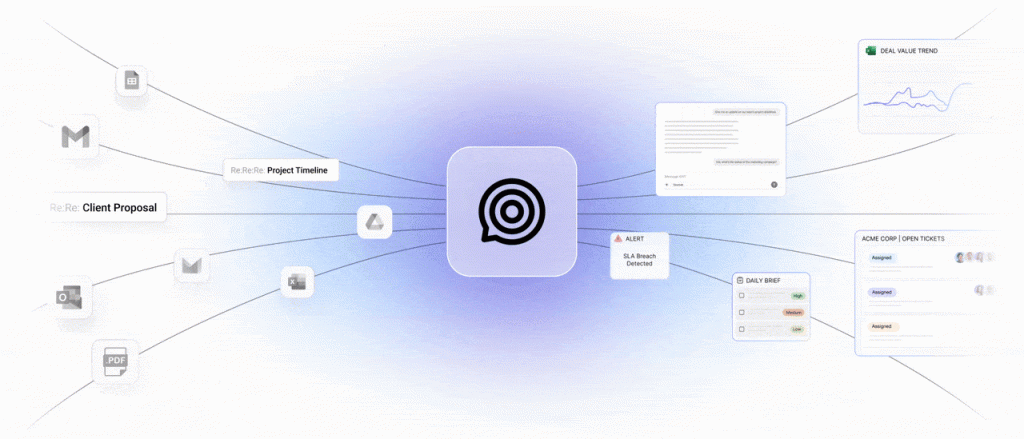
Email is still the backbone of how companies actually work, the place where decisions get made, and commitments get documented. Context lives across months and years of conversation.
Still, somewhere along the way, we convinced ourselves it needed fixing and started piling layers on top of each other until we forgot what we were even looking at.
Gmail added tabs and categories to organize the flood, Superhuman optimized for speed like the problem was how fast you could archive, Slack tried to replace email entirely with real-time channels that turned every conversation into noise that disappeared unless you happened to be online when it happened.
And, a thousand plugins promised to surface what matters, summarize threads, automate responses, integrate with everything, each one adding another layer of abstraction between you and the actual structure of your communication.
None of these tools is wrong, but email feels overwhelming. They’re solving the wrong problem because they misunderstand what email actually is.
Email isn’t a filing cabinet that got out of control. It’s conversational infrastructure that encodes how your company really operates:
- who committed to what
- what changed over time
- where accountability lives
We’ve been treating it like a document storage system for so long that we forgot it was designed for conversation from the beginning.
What building Spike taught us
We built Spike because email threads are conversations, they always have been, and every tool that tried to “fix” email by adding more organizational layers was just making it harder to see the actual conversational structure underneath.
Look at how email actually works.
Threads aren’t isolated messages, they’re ongoing conversations with participants who have context and history together, where replies build on previous replies and cc lines show who needs to know what, and silence after a direct question carries meaning, and forwarding a thread to someone new requires explaining the entire backstory because the context lives in the flow of the conversation, not in any single message.
This is conversational infrastructure that got formatted with headers and quoted text. Users kept trying to organize it like a document when they should have been reading it as dialogue.
So, we stripped away the layers and built an interface that respects what email actually is: conversational, threaded, contextual, ongoing.
No cramming the UI with integrations, plugins, or features that obscure the conversation. Just email as it should be read, like the ongoing dialogue between people that it actually is.
Spike now has millions of teams & professionals worldwide using it daily, and we’ve watched how people actually interact with their email when you stop treating it like a filing system.
Here’s what we learned: showing email as a conversation was necessary but not sufficient.
The layer we couldn’t surface with a UI
Even with a perfect conversational interface, the real context doesn’t live inside individual messages. It lives in the pattern of how conversations evolve. And surfacing that pattern requires actually reconstructing it from the underlying structure, which is a different problem than displaying it correctly.
A client emails you in December about project pricing, and you send a detailed breakdown. In January, they follow up to ask about the timeline’s feasibility, and you explain the dependencies. February goes quiet. In March, they resurface to ask whether the original pricing still holds.
Any email client will show you those four messages if you search for them. Spike will show them as a conversation thread that’s easier to follow. But what’s actually happening is that this client has been price-shopping, hit delays on their end, and is now trying to lock in your December quote even though your costs have changed.
That context lives in how the relationship evolved over those months, not in any single message, and no conversational UI can surface it because it requires understanding the pattern across time.
Or consider an employee who references a commitment you made six months ago in an email thread, then mentions it again in Slack last week, then follows up today in a different email thread entirely.
Three separate conversations across two platforms over six months. Each tool shows you discrete messages, but the actual context is a broken accountability chain that’s about to explode because someone thinks you promised something. You half-remember saying it, but can’t trace the full thread of what was actually committed, what was implied, and what changed later.
This is what email intelligence actually means. Not another layer on top, or better search or summaries, but actually understanding how conversations connect over time to show you:
- Who said what to whom and when
- What was committed versus what was questioned versus what got quietly dropped
- Which conversations are related even when separated by weeks or different subject lines
- What changed between Thread A in December and Thread B in March that shifts the entire meaning of what’s happening now
Why we built iGPT

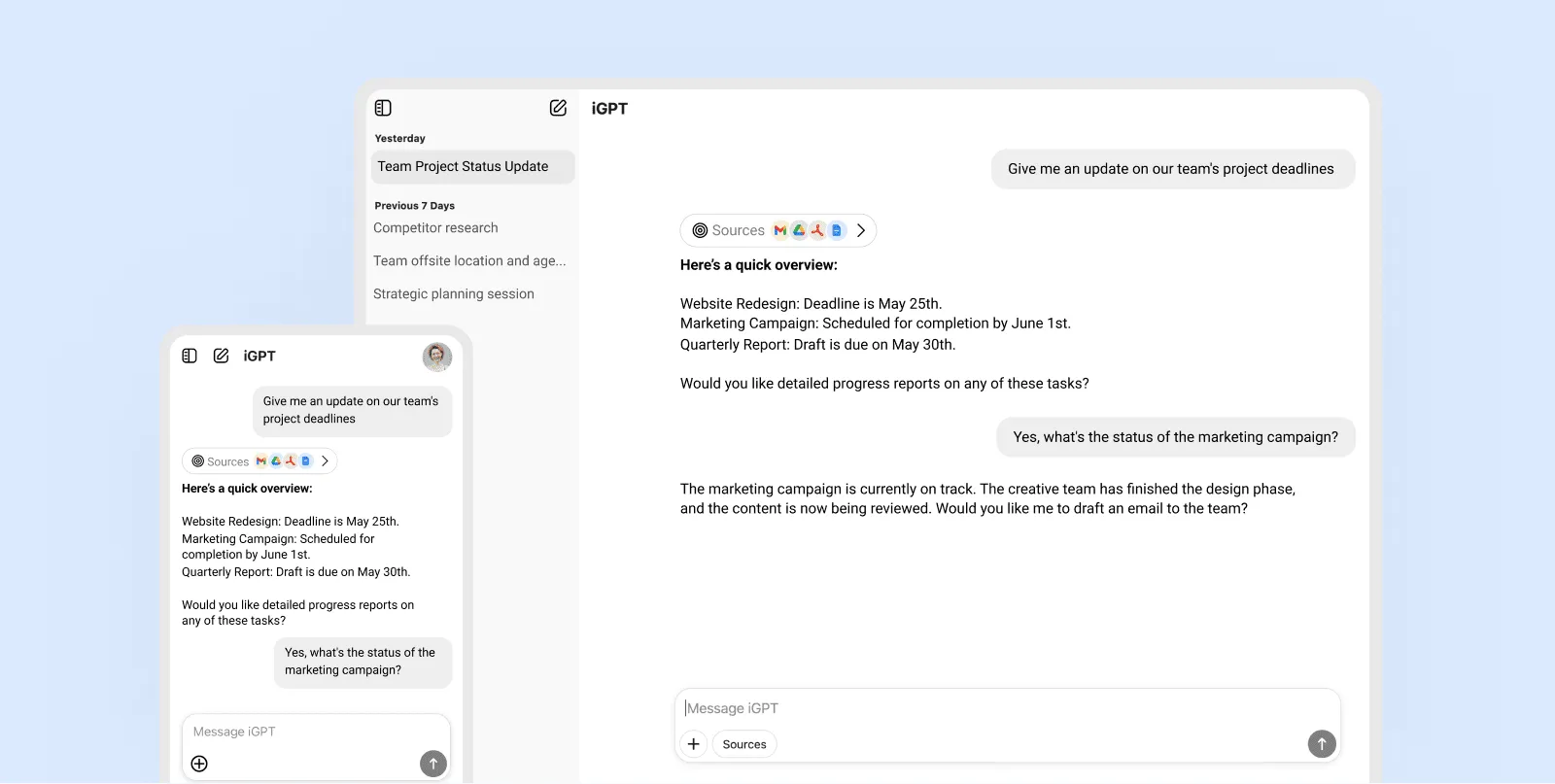
iGPT is what happens when you take everything we learned building Spike and turn it into something you can talk to.
Instead of searching through emails hoping you find the right thread, you just ask:
“What’s the status with the client?”
And instead of getting a list of emails that mention them, you get the actual picture: they were enthusiastic in December, went quiet after your January timeline conversation, and resurfaced last week asking about the original pricing.
The relationship has cooled, and they’re price-shopping. You probably shouldn’t offer the same terms.
“What’s falling through the cracks this week?”
And instead of manually reviewing your inbox, you see the threads where someone asked a direct question and got no response, the commitments that are coming due without follow-up, the conversations that went from active to silent after a tense exchange.
The stuff that’s about to become a problem if nobody catches it.
Most AI tools treat email like a pile of text to search through. They find messages that match your keywords and show you snippets.
iGPT treats email like what it actually is: a record of relationships evolving over time. It understands that silence means something, that tone shifts matter, that a commitment in one thread connects to an expectation in another thread three months later.
You stop searching and start asking. And the answers come back in seconds, even if the context spans years of conversation, because the system already understands how everything connects.
What this means
Email never stopped being central to work. It’s still where companies make decisions, document commitments, and build relationships over time. Still, the universal open protocol survived every attempt to replace it because it actually works as conversational infrastructure at scale.
We just forgot how to read it because we kept adding layers that obscured its structure. The progression was straightforward once we saw it:
Spike proved you could strip away the layers and show email as a conversation, which is what it always was.
iGPT proves you can actually understand those conversations well enough to answer questions about them: who said what, what changed, what connects across time, and where the broken commitments, shifting relationships, and evolving context actually live.
Not another tool on top of email. Actually understanding what’s underneath.