"Per My Last Email" and Other Signs Your Communication Stack Is Broken



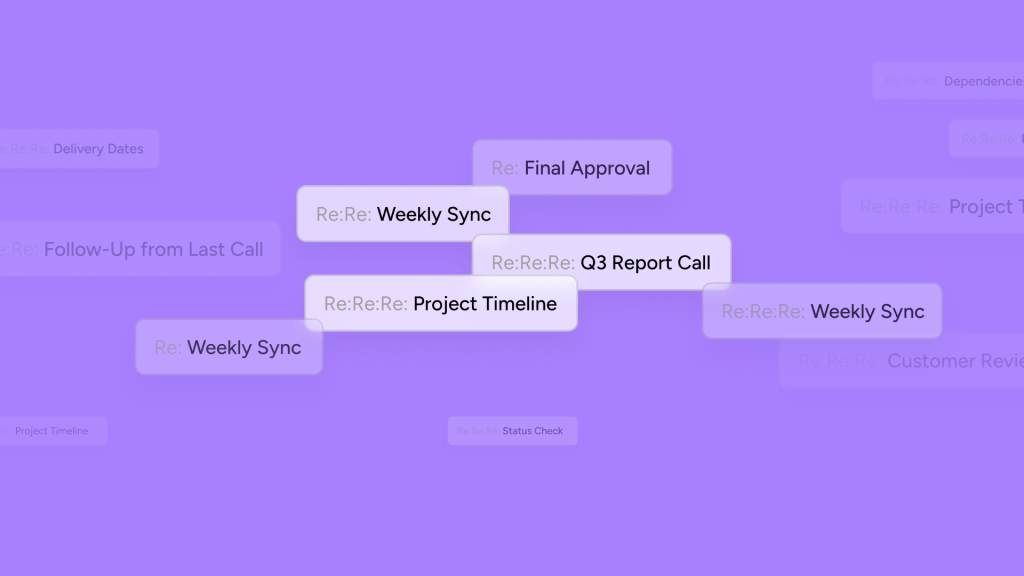
“Per my last email” has its own merch now. There are mugs, t-shirts, TikTok accounts, and an entire genre of workplace comedy built around four words that really mean “I already told you this and I’m annoyed that I have to say it again.”
It’s funny. It’s also a symptom.
Not of bad manners or poor reading comprehension. Of a communication format that forces people to be formal when they want to be direct, slow when they want to be fast, and performatively polite when they’re actually frustrated. Email doesn’t make people passive-aggressive. But it does give passive aggression the perfect habitat.
The formality tax
Nobody writes “per my last email” in a text message. Nobody writes “I hope this email finds you well” in a Slack DM. Nobody writes “please see attached” to a friend. These phrases exist only in email, because email is the one communication channel where everyone still feels obligated to perform professionalism.
Think about the last email you sent to a coworker. You probably wrote a greeting, a preamble, the actual point (buried in paragraph two), a softening phrase, and a sign-off. Five components for what could have been one sentence: “The deadline moved to Friday.”
That’s the formality tax. You pay it on every message, and it compounds across the 40 emails you send per day. At roughly 70 seconds per email, the ceremony of sounding professional eats hours every week. Not because the information is complex, but because the format demands a performance that nobody enjoys giving or receiving.
The memes about email culture aren’t making fun of email. They’re making fun of the performance. “Just circling back” means “you didn’t respond.” “As previously mentioned” means “read the thread.” “Happy to discuss further” means “please stop emailing me about this and just call.” Everyone knows the translation. Everyone keeps performing anyway.
Why email got this way
Email was designed in an era when sending a message to someone was an event. You composed it, sent it, and waited. The format reflected that weight: subject lines, salutations, full paragraphs, signatures. It was digital letter-writing, and the conventions made sense when you sent five messages a day.
Nobody sends five messages a day anymore. The average professional receives over 120 emails daily and sends about 40. The format didn’t scale, but the conventions stuck. So now you’re writing formal letters 40 times a day to people you sit next to, people you talked to 10 minutes ago, people you’ll talk to again in an hour. Each message carries the overhead of a document when it should carry the weight of a sentence.
This is where the frustration lives. Not in email as a technology, but in email as a format. The technology works fine. Messages arrive, attachments attach, search finds things. What doesn’t work is the expectation that every message needs a subject line, a greeting, three paragraphs of context, and “Best regards.”
That expectation is why “per my last email” exists. When the format forces you to write three paragraphs to say “I already answered this,” the irritation has nowhere to go except into the phrasing.
The tools people use to escape email are just more email
Here’s the thing that doesn’t get said enough: Slack didn’t fix this. Neither did Teams. They replaced email’s formality with a different problem, which is that now you have two inboxes instead of one, and the important stuff could be in either.
The promise of workplace chat was that it would handle the quick, informal communication that email was bad at. And it did, sort of. But in practice, most teams now run a parallel communication system where some conversations happen in email (usually anything involving people outside the company), some happen in chat (usually internal), and nobody is entirely sure which channel has the definitive version of any given decision.
The memes shifted, too. “Per my last email” became “as I mentioned in Slack” became “I think we discussed this on the call” became the universal office experience of knowing that a conversation happened but not being able to find it.
Adding more channels didn’t solve the format problem. It multiplied the surface area where information gets lost.
What the memes are actually about
The passive-aggressive email phrases that everyone laughs about online are all expressions of the same underlying frustration: the gap between how fast we think and how slowly email makes us communicate.
“Per my last email” = I already said this, but the format buried it.
“Just following up” = I need an answer, but the format requires me to pretend I’m being casual about it.
“As discussed” = We resolved this verbally, but the format requires a written record, so here I am recreating a conversation in paragraph form.
“Please advise” = I need you to make a decision, but the format won’t let me just say “what do you want to do?”
“I hope this email finds you well” = I have absolutely nothing to say here, but the format won’t let me start with the point.
Every one of these is a workaround for a format that doesn’t match how people actually communicate in 2026. The memes are diagnostic. They’re telling you that the gap between how your team talks (fast, direct, informal) and how your tools make them write (slow, formal, padded) is creating friction that shows up as humor, frustration, and eventually, missed communication.
The format is the problem, not the people
The instinct when email culture gets toxic is to write a “communication guidelines” doc. Set expectations for response times. Agree on when to use email vs. chat. Establish norms. This helps, a little, temporarily, until everyone forgets the guidelines and goes back to whatever was easiest.
The reason guidelines don’t stick is that they’re fighting the format. You can’t make email feel casual by agreeing to be casual, because the format itself signals formality. The subject line, the header, the quoted text from previous replies, the signature block, all of it tells your brain “this is a formal communication” even when the content is “hey, the meeting moved to 3.”
Some teams solve this by moving everything to chat. But then you lose the things email does well: working with people outside your organization, having a searchable record, handling longer and more complex communication that doesn’t fit into chat messages.
The actual fix is a format change. Not a policy change, not a new channel alongside the old ones, not a guidelines doc. A different format that preserves what email does well (universal, searchable, asynchronous) while dropping what makes it painful (the ceremony, the formality, the performance).
What a better format feels like
You’ve already experienced the better format. You use it every day. It’s the way you communicate on every platform that was designed in the last 15 years: chat-style, conversational, grouped by person, fast.
When you text someone, you don’t write a subject line. You don’t start with “I hope this message finds you well.” You don’t sign off with “Best regards.” You say the thing, they say the thing back, and the conversation is a clean thread of messages that both of you can scroll through to find what was said.
That format works for 95% of the communication that currently happens over email. The other 5%, the formal proposals, the legal correspondence, the board communications, can stay formal. But the daily back-and-forth between you and your team, between you and your clients, between you and the 40 people you email every day, doesn’t need the ceremony. It needs the speed and clarity of a conversation.
The interesting part is that this doesn’t require your contacts to change anything. Email is a protocol, not an app. The format of the experience is determined by the tool you use to read and write it, not by the technology underneath. Your contact sends you a formal email. You read it as a chat message. You reply with two sentences. They receive a normal email. The formality drops on your side without anyone else noticing.
The memes will tell you when it’s working
Here’s how you know your communication format is right: the memes stop being relatable.
When “per my last email” doesn’t describe your experience anymore because your replies are two sentences and the conversation is right there in front of both of you, the format is working. When “just following up” stops being necessary because you can see whether someone read your message, the format is working. When “as discussed” disappears because the discussion and the email live in the same thread, the format is working.
The passive-aggressive phrases aren’t personality flaws. They’re coping mechanisms for a format that makes direct communication feel rude. Change the format, and the coping mechanisms become unnecessary.
Your team doesn’t need a communication workshop. Your inbox needs an upgrade.
Try Spike
Spike turns email into a conversation. You write like you’re texting. Your contacts receive a normal email. Same protocol, better format.
Free plan. Works with Gmail, Outlook, and any IMAP account.