Why Your Team Uses Too Many Communication Apps



A client replies on Tuesday. The email lands in the personal Gmail you opened first this morning, while the work Gmail with that client’s thread sits in a different tab you haven’t checked since 9 am. Your coworker sees the reply, pings you in Slack to say, “Did you see that?”
By the time you switch back, another teammate has already answered on a Zoom call you weren’t on. The decision made on the call is added to Asana as a task. Four apps, one conversation, and you’re the last person in your own company to know what got decided.
This is the setup most professionals are running in 2026. Four communication apps, four notification streams, four places where context goes to die. The reason isn’t that any of these tools are bad.
They solved real problems when they showed up. Gmail handled email. Slack handled the stuff that was too fast for email. Zoom handled the stuff that was too complicated for Slack. And because decisions kept slipping through, you added a task manager to catch what was falling through the cracks.
Reasonable decisions, every one of them. Then the phrase “too many communication apps” started showing up in your team’s retrospectives, and you realized the stack you built to stay organized had become the reason nothing felt organized anymore.
The conversation that lives in four places
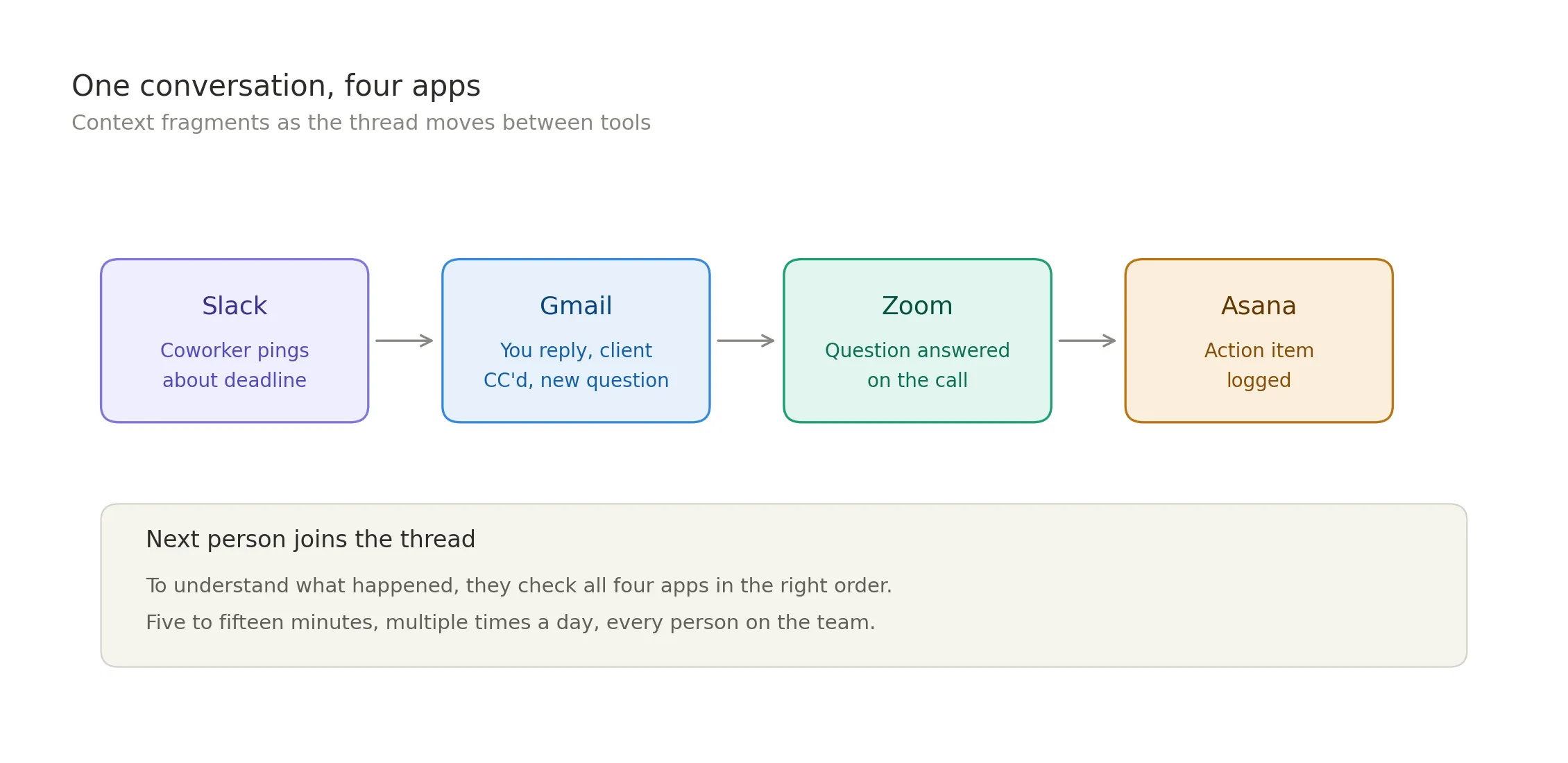
Your coworker sends a Slack message about a client deadline. You reply via email because the client is CC’d. The client responds with a question. Your coworker answers it on a Zoom call. The action item from that call is added to Asana. And the next person who needs to understand what happened has to check all four apps in the right order to reconstruct a conversation that should have been a single thread.
That is Tuesday. It is also Wednesday, and it will be Thursday.
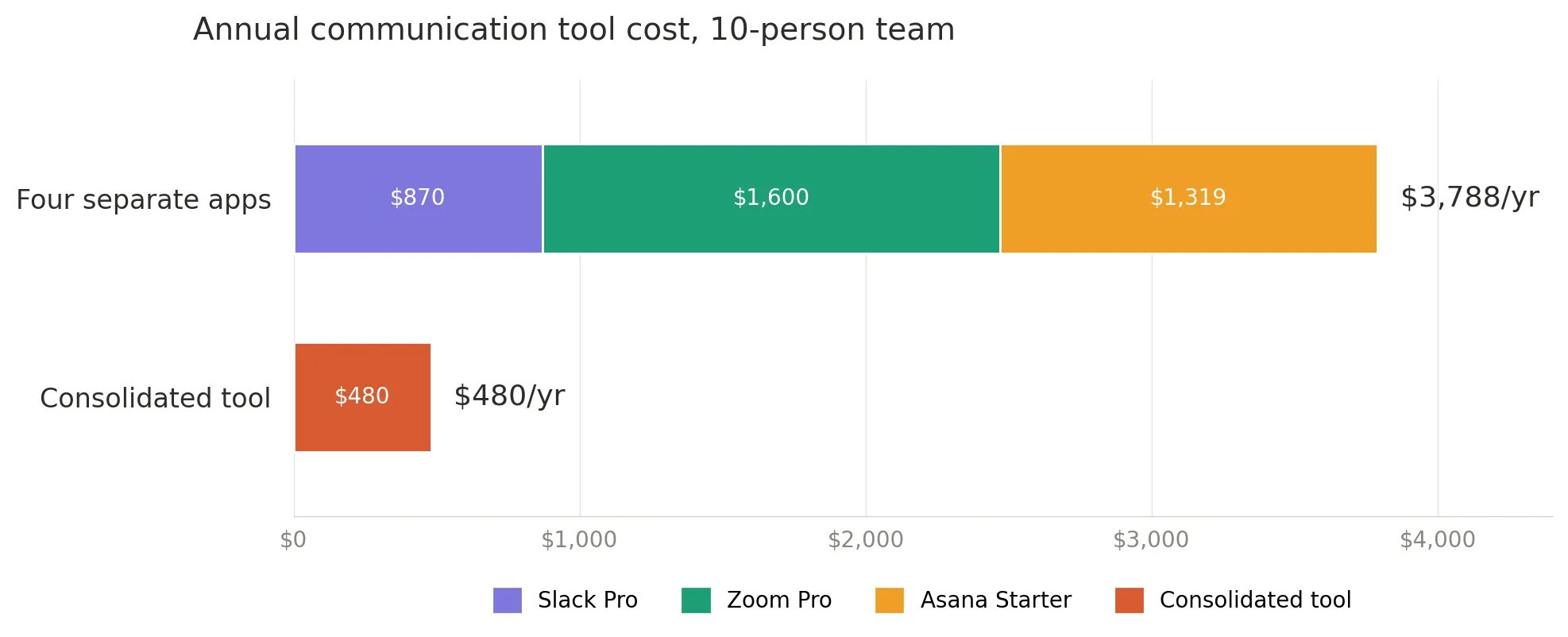
The real cost shows up in two places. The first is money, and the math is dull but concrete. For a 10-person team paying for Slack Pro at $7.25 per user per month, Zoom Pro at $13.33 per user per month, and Asana Starter at $10.99 per user per month on top of free Gmail, you’re at roughly $31.50 per person per month. Around $3,800 a year in subscriptions for four tools that were supposed to make communication easier, and mostly made it more diffuse.
The second cost is bigger, and nobody tracks it. That’s the 20 minutes each person spends every day switching between apps, rereading messages they already saw in a different context, and asking, “Where was this discussed?” That question is the unofficial motto of every company running four communication tools.
Why adding another app doesn’t fix anything
The instinct when communication breaks down is to add something. A project management layer. A wiki. A shared doc that tracks who said what. Each addition feels like progress, and each one quietly becomes a fifth place where information gets lost.
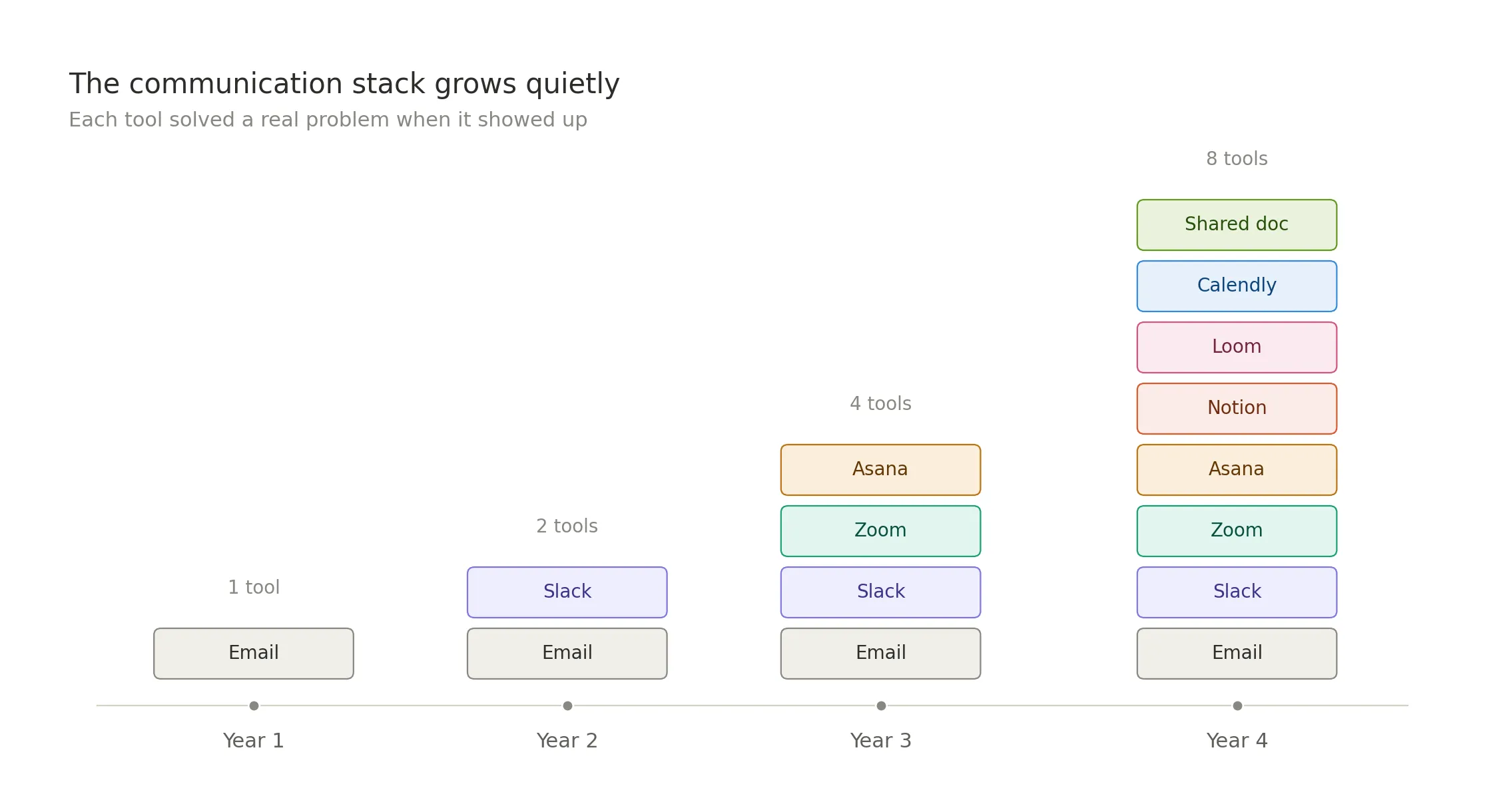
This is how a 5-person startup ends up with 8 tools. It happens gradually, and each decision made sense at the time. The cumulative effect is that your team’s knowledge sits scattered across platforms that don’t share context, don’t sync state, and definitely don’t know that the Slack message, the email, and the Zoom recording are all part of the same conversation.
The fragmentation creates a specific kind of dysfunction that’s hard to name but easy to feel. Decisions made in Slack never reach the people who only check email. Context shared in the email is invisible to the team members who live in Slack. And the meeting where the final call was made? That’s in a Zoom recording nobody will ever watch again.
The “where was this discussed?” tax
Every time someone asks, “Where was this discussed?” your team pays a tax. Not a financial one. A cognitive one.
Someone stops what they’re doing, searches Slack, doesn’t find it, opens Gmail, searches there, checks Asana, maybe finds a comment that references it, clicks through to the original thread, and then has to read up from the middle of a conversation to understand the context. Five to fifteen minutes, multiple times a day, across every person on your team. Multiply that across a 10-person company, and it’s a few hours a week burned on information retrieval that shouldn’t need to happen if the conversation had lived in one place.
The worst version of this is when nobody asks. When the project lead just makes a decision based on incomplete information, it is because checking four apps felt like too much work. That’s when things go sideways quietly. A deadline moves, but the client’s email doesn’t reflect it. An approval is given in Slack, while the task in Asana still shows as pending. The information exists, technically. It exists in the wrong app for the person who needs it.
What consolidation actually looks like
Better integration has been sold as the answer for a decade, and a decade of Slack-to-Gmail integrations has mostly produced twice the notifications and half the clarity. Piping notifications between apps is not the same as putting conversations in one place.
What works is fewer tools doing more.
This sounds obvious. There’s a reason people still resist it: all-in-one tools have a reputation for being bad at everything, and a 2012 version of that fear was largely justified. Chat was Skype, Skype was terrible, and consolidating meant accepting trade-offs on every surface.
That fear has quietly gone out of date. One app can handle email, team chat, tasks, and video calls without being bad at any of them, because the underlying capabilities are no longer that differentiated. The real question has shifted from can one app do all of this? to does it do each thing well enough that my team won’t fight me on the switch?
And the bar for well enough is lower than most teams assume. Most Slack usage is in channels and DMs. Most Zoom usage is starting a call and sharing a screen. Most task-manager usage is checking items off a list. The advanced features are real, and for 80% of teams, they’re also unused. What remains unsolved isn’t the functionality. It’s the consolidation — having one place where the client email, the internal discussion, and the task it generated all live together.
The math nobody wants to do
The arithmetic is straightforward once you put it on paper.
A 10-person team running Gmail, Slack Pro, Zoom Pro, and Asana Starter lands at around $31.50 per person per month. That’s roughly $3,800 per year in subscriptions for communication alone.
A consolidated tool that handles email, team chat, video calls, and tasks typically runs $4 to $10 per user per month. Call it $50 to $120 per person per year.
The subscription savings are real. They’re honestly the less interesting part. The more interesting part is what happens to the “where was this discussed?” tax once the answer is always here.
The client email, the internal thread, and the task it generated all reside in the same app and are visible to the same people. Nobody has to reconstruct the conversation across four platforms because it never left one.
The clients-are-on-Gmail problem isn’t a problem
The biggest objection to switching communication tools is almost always the people outside your team. Your clients are on Gmail. Your vendors are on Outlook. Your freelancers are on whatever they use. You can’t ask all of them to switch.
This objection dissolves the moment you remember that email is already interoperable. When you send an email from a consolidated tool, the recipient gets a normal email. They don’t need your app. They don’t know you switched. They don’t care. Email’s greatest strength, the thing people forget when they complain about it, is that it works with everyone on the planet who has an email address.
The consolidation happens on your side. Your contacts keep using whatever they use. They get a normal email. You get everything else.
What to actually evaluate
If you’re looking at consolidated tools, the features that matter aren’t the ones on the comparison chart. They’re the ones that determine whether your team still opens the app in week three.
Does your email look the same to external contacts? If your clients can tell you switched email clients, something is wrong. Can you add multiple email accounts to one inbox, since most professionals have at least two? Is the team chat inside the email or alongside it? If it’s a separate tab, you’ve just recreated the Slack problem. Can you start a video call from inside a conversation rather than from a separate meetings page? Are tasks connected to the messages they came from? If tasks live in their own silo, where was this discussed? comes back inside a single app.
Four questions. If a tool answers yes to all four, it’s a real consolidation. If it only answers yes to two, you’re about to add a fifth app to your stack.
Try Spike
Spike is built for exactly this. Email, team chat, tasks, video calls, and collaborative docs — all in a single app, with conversations that live in one place instead of scattered across four. External contacts still get normal emails. Your team gets everything else in one thread.
Free plan available. Works with Gmail, Outlook, and any IMAP account.